You Don't Need Authority to Improve a Process
In most SMEs, improvements stall not from lack of ideas, but from waiting for approval. The fastest, lowest-cost gains come from frontline-driven action. Build a culture that empowers operators to fix issues—unlocking sustained cost reduction and stronger cash flow.

The Problem: Good Ideas Die in the Waiting
Walk into almost any manufacturing workshop in Australia and you'll find the same pattern. The operators know exactly what's slowing them down. The leading hand can tell you which jig doesn't hold properly. The storeman knows which parts are always short. The welder knows the sequence is wrong.
But nothing changes.
Not because people are lazy. Not because the problems are hard. Because everyone is waiting for someone with authority to make the call.
This is one of the most expensive habits in manufacturing. It's invisible on your P&L, but it shows up everywhere: in rework, in overtime, in missed deliveries, in scrap bins that fill up faster than they should.
I've spent 25 years in engineering, production, and operations — from the toolmaking bench to R&D, from designing jigs and fixtures to commissioning entire production lines. And I can tell you from direct experience: the most impactful improvements I've delivered didn't require executive approval. They required observation, a bit of engineering thinking, and the willingness to act.
The Cost of Waiting for Permission
Let's put some numbers on this.
Consider a typical SME manufacturer running a production line with 10 operators. Each operator encounters, on average, two small inefficiencies per shift — a tool that's in the wrong spot, a drawing that's unclear, a fixture that needs shimming every time, a process step done out of sequence.
Each of those small friction points costs roughly 5–10 minutes per occurrence.
| Factor | Value |
|---|---|
| Operators on line | 10 |
| Small inefficiencies per shift per operator | 2 |
| Average time lost per inefficiency | 7.5 minutes |
| Shifts per week | 5 |
| Weeks per year | 48 |
| Total lost hours per year | 600 hours |
| Loaded labour rate (AUD) | $65/hr |
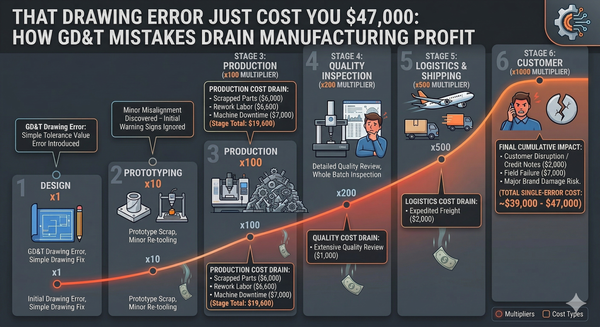
| Annual cost of "waiting for permission" | $39,000 |
That's nearly $40,000 a year — just in direct labour. It doesn't account for the downstream effects: late deliveries, quality escapes, customer complaints, or the slow erosion of team morale when people feel their observations don't matter.
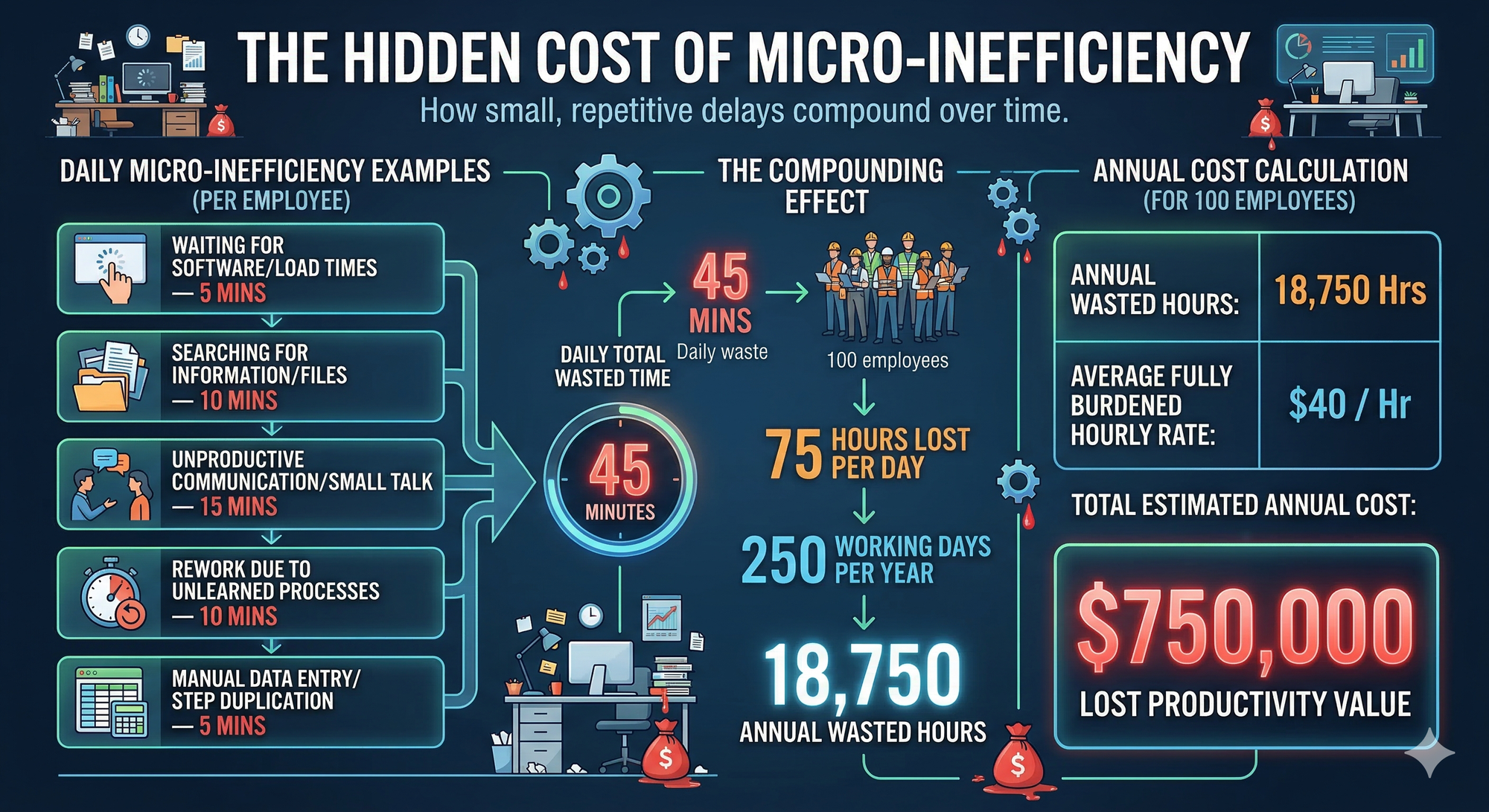
Illustration: Stacked cost of small daily inefficiencies compounding across a 10-person line over 48 weeks.
Now multiply that across two or three production lines. You're looking at $80,000–$120,000 in recoverable waste — without buying a single piece of equipment.
The Lean Principle Behind This: Point Kaizen
In Lean manufacturing, the concept that addresses this directly is called Point Kaizen — sometimes referred to as "Just Do It" Kaizen.
Point Kaizen is a small, incremental improvement made at a specific point in the process. It's typically initiated by the person doing the work. It doesn't require a formal project charter, a Gantt chart, or a Six Sigma Black Belt. It requires someone noticing a problem and fixing it — today.
Here's the maths that makes Point Kaizen powerful:
If 100 employees each make one small improvement per day, that's 5,000 improvements in a single year.
Toyota — the company that pioneered this thinking — generates roughly 70 improvement ideas per worker per year. The average Australian manufacturer? Closer to zero, because the culture doesn't support it.
The difference isn't talent. It's permission.
| Organisation Type | Improvement Ideas per Worker per Year |
|---|---|
| Typical Australian/US manufacturer | 0.5 |
| Typical Japanese manufacturer | 9 |
| Toyota | 70 |
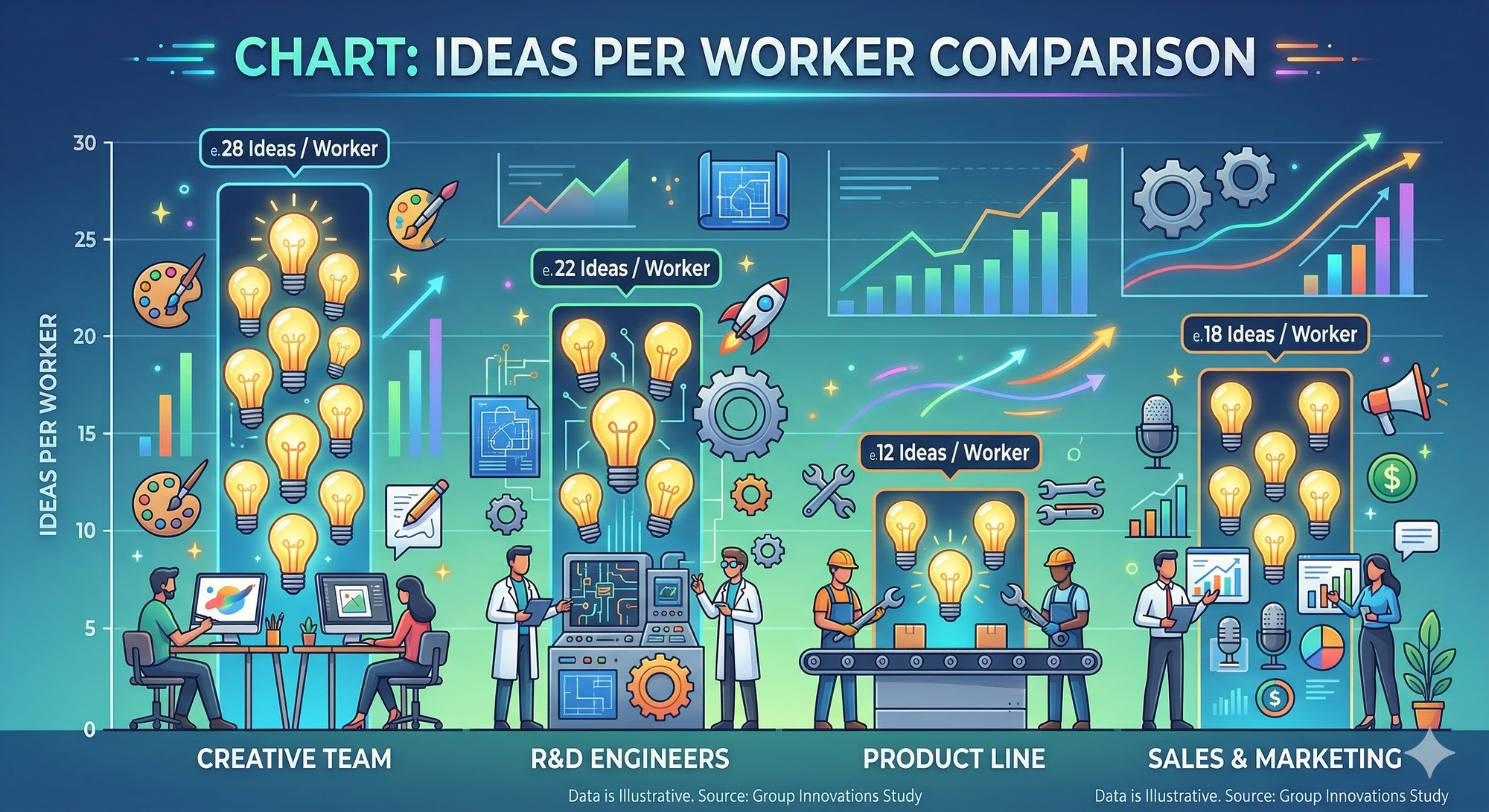
Illustration: Bar chart comparing annual improvement ideas per worker across organisation types.
Why This Matters for SMEs More Than Anyone
Large corporations can absorb inefficiency. They have margins, buffers, and departments dedicated to continuous improvement.
Small and mid-sized manufacturers don't have that luxury. In an SME with $10M–$50M turnover and thin EBITDA margins, every dollar of waste hits harder. Every hour of lost productivity is felt. Every quality escape risks a customer relationship that took years to build.
But here's the opportunity: SMEs are also faster. There are fewer layers between the person who sees the problem and the person who can approve the fix. In many cases, they're the same person.
The question isn't whether your people can improve processes. It's whether your business gives them the framework to do it.
What This Looks Like in Practice
When I set up the Ventus Louvre production line in Sydney, the budget was under $50,000. There was no room for consultants, committees, or extended planning cycles. The entire line — jigs, fixtures, workflow, ERP routing, standardised work, error-proofing — had to be designed, built, and commissioned with a lean team and a tight timeline.
The improvements that made that line work didn't come from a boardroom. They came from:
- Watching operators work and noticing where they hesitated, doubled back, or reached too far.
- Mapping the value stream to see where time was being consumed without adding value.
- Designing poka-yoke into fixtures so that errors couldn't happen in the first place — rather than relying on inspection to catch them later.
- Configuring ERP routing so the system drove the workflow, not paper or memory.
- Standardising work sequences so every operator could deliver consistent output from day one.
None of these required executive authority. They required engineering thinking applied at the point of work.
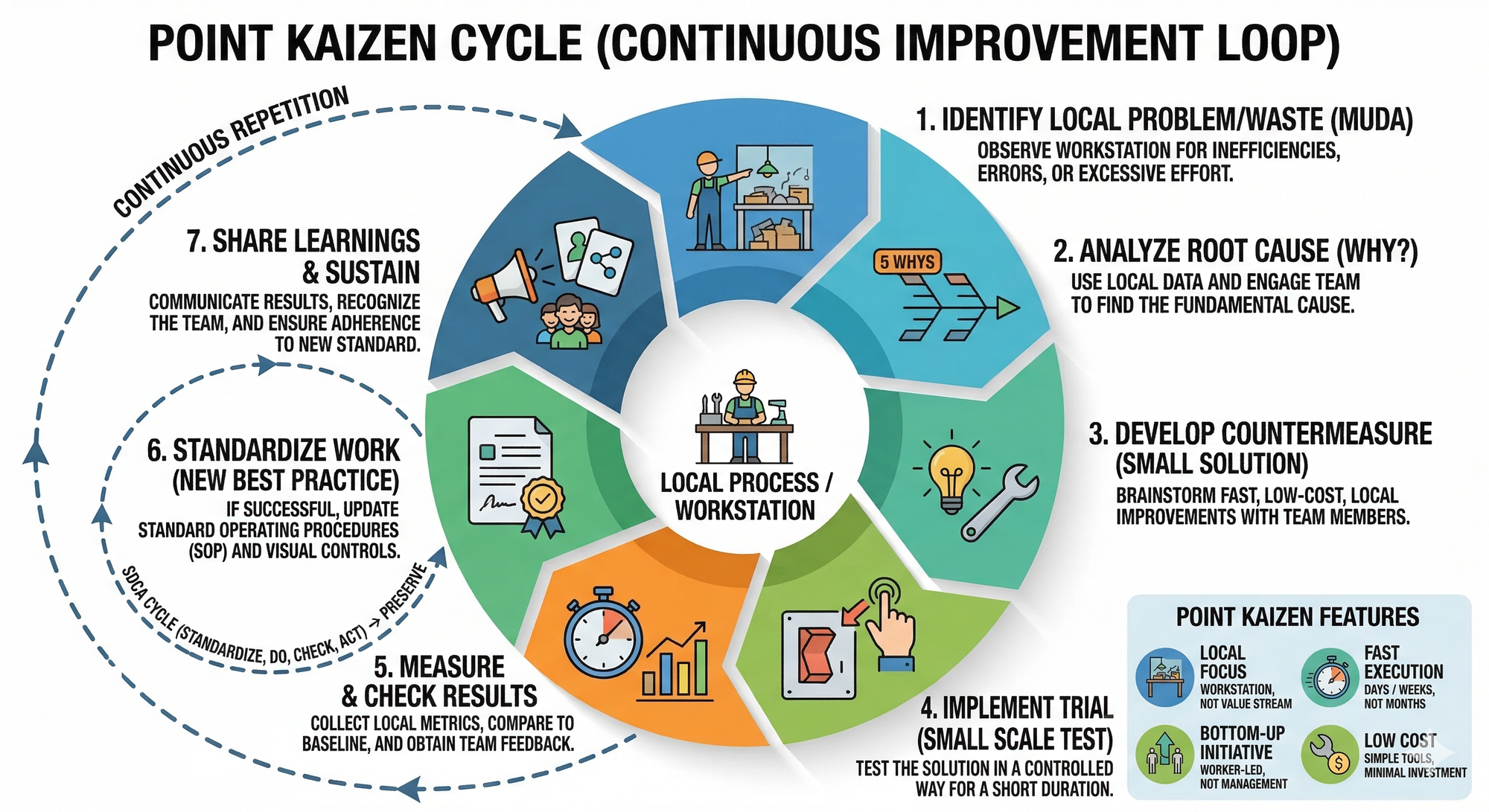
Illustration: Circular diagram showing Observe → Identify Waste → Fix at Source → Standardise → Repeat.
How to Build a Culture Where This Happens
If you're a business owner or operations manager in an Australian manufacturing SME, here are five practical steps to unlock frontline-driven improvement — starting this week.
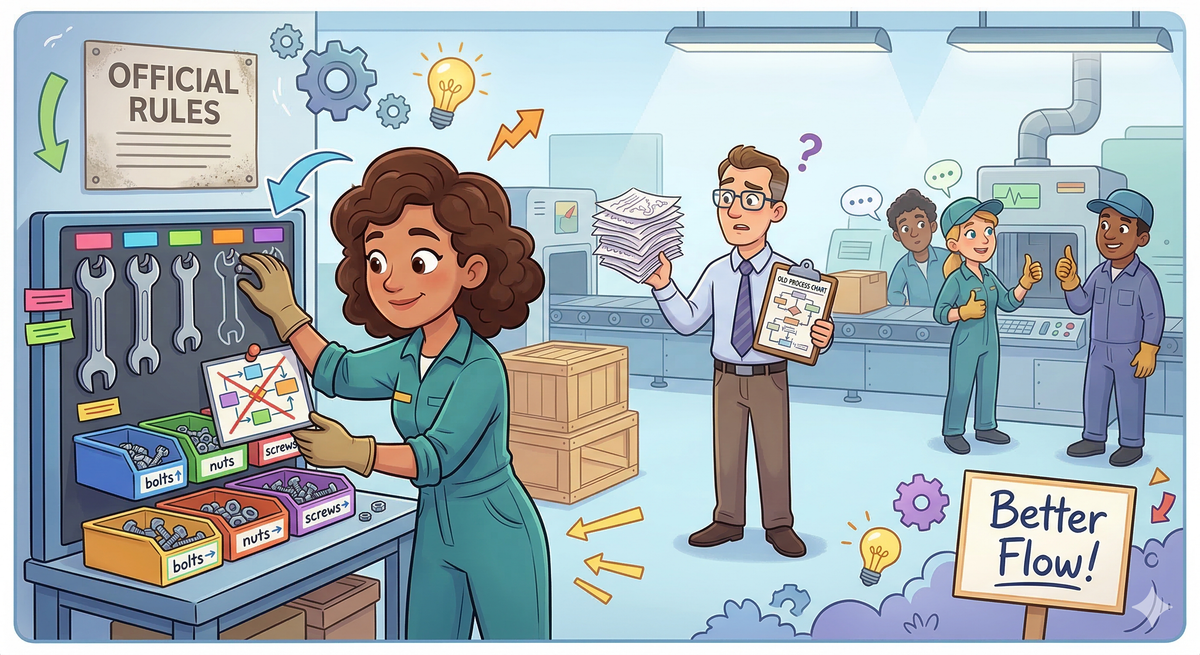
1. Make "Just Do It" Official
Give your team explicit permission to fix small problems without approval. Define a threshold — say, any improvement that costs less than $200 and takes less than one hour to implement. Below that threshold, the answer is always yes.
2. Create a Simple Capture System
You don't need software. A whiteboard near the production line with three columns — Problem | Fix | Result — is enough to start. The act of writing it down makes the improvement visible and shareable.
3. Walk the Floor Weekly
Gemba walks — going to the actual workplace to observe — are non-negotiable. You can't improve what you don't see. Spend 30 minutes per week on the shop floor, not to audit, but to ask one question: "What's slowing you down?"
4. Standardise What Works
When someone finds a better way, document it. Update the work instruction. Make the new method the standard. This is how small improvements compound into systemic gains. Without standardisation, improvements evaporate with the next shift change.
5. Recognise and Share Wins
Publicly acknowledge improvements — even small ones. Mention them in toolbox talks. Put them on the noticeboard. When people see that their ideas are valued and implemented, they generate more of them.
| Step | Action | Cost | Time to Implement |
|---|---|---|---|
| 1 | Define "Just Do It" threshold | $0 | 1 day |
| 2 | Install improvement whiteboard | < $50 | 1 day |
| 3 | Schedule weekly Gemba walk | $0 | 30 min/week |
| 4 | Update work instructions after each fix | $0 | 15 min per fix |
| 5 | Share wins in toolbox talks | $0 | 5 min/week |
The Engineering Mindset Behind This
I started my career as a toolmaker. In toolmaking, you learn something that many managers never do: the person closest to the work understands the work best. A toolmaker doesn't wait for permission to adjust a die. A machinist doesn't raise a purchase order before re-clamping a workpiece. They see the problem, understand the physics, and fix it.
That mindset — observe, analyse, act — is the foundation of every meaningful process improvement I've ever delivered. Whether it's reducing cycle time on a CNC cell, redesigning a fixture to eliminate rework, or setting up an entire production line from scratch, the principle is the same.
You don't need authority to improve a process. You need clarity about what the process should achieve, the skill to see where it falls short, and the discipline to fix it properly — not with a workaround, but with a standardised, sustainable solution.
Key Takeaway
The most expensive process improvements are the ones that never happen because someone was waiting for authority. In Australian SMEs, where margins are tight and every dollar counts, the fastest path to reducing cost is empowering the people who do the work to fix what's broken — today, not next quarter.
Your shop floor is full of $39,000 problems disguised as "that's just how we do it." The question is whether your culture lets people fix them.
Ready to Find the Hidden Costs?
If you want help identifying cost leaks in your business, I offer a short CostDown Audit to uncover hidden savings — no committees required. Just practical, engineering-driven analysis that turns observations into dollars.